The tally sheet lies crumpled in the pickup, the pile number is only on a scrap of paper, and in the evening someone at the office types the figures into a spreadsheet. That takes time and leads to typos. And when the buyer asks exactly where pile 14 is and how much is still on it, the search begins.
This guide explains how timber recording and log pile measurement work, what belongs in a good tally sheet, how paper, Excel and an app compare, and what to look for in a timber recording app.
Measuring methods and terms in brief
Trade customs as the framework. Raw timber trading in Switzerland follows the Swiss trade customs for raw timber («Schweizer Handelsgebräuche für Rohholz»), 2021 edition, in force since 1 September 2021. They are backed by the Swiss forestry and timber associations WaldSchweiz, Holzindustrie Schweiz, Holzbau Schweiz and Lignum. They describe the assortments of roundwood, industrial wood and energy wood, set out how billable volumes are determined and, in their commercial section, define terms such as quantities, dates and deadlines. The measuring details are in the rulebook itself (114 pages, available from Lignum). If in doubt, the purchase contract states which measuring method applies.
Single-log measurement. The diameter is measured with a calliper, plus the length. The volume is calculated from these: measuring devices only record measured values, the volume is a calculated result. Depending on the requirements, diameters can be measured over or under bark (FVA, 2018). So always note how you measured.
Stacked volume (stere). With a log pile, you don't measure every piece but the stack as a whole: the pile front and pile depth give a stacked volume. This volume includes the gaps. That is why it cannot simply be converted into solid cubic metres.
Stere and solid cubic metre. There is a documented factor for firewood logs: the Swiss wood energy statistics (Swiss Federal Office of Energy, SFOE) use 1 m³ solid = 1.4 steres for log-fired heating. This value does not apply across the board to roundwood piles. What counts is the agreement with the buyer or the rulebook.
Standing and felled. A distinction is made between recording standing timber (before felling, at marking) and felled timber. Before felling you have estimates, after processing you have measured values. Both should be kept clearly separate in your analyses.
Photo-optical log pile measurement. A widespread technique: the visible pile front is photographed and analysed, and the volume is calculated as stacked volume (FVA, 2018). In a field test by FVA Baden-Württemberg (forest research institute; 2016, Germany, one app), 72 % of industrial wood lots were within ±5 % of the mill measurement for stacked volume. For the volume of fixed lengths, only 6 of 69 lots were within ±3 %. The test names photo documentation and no need for chemical marking as advantages, and dependence on how the camera is held, lighting and a neatly stacked pile as disadvantages.
Checklist: what a good tally sheet and pile record contain
This is a recommendation from practice, not a regulation. Anything else your buyer requires is in the contract.
- Pile number, unique and clearly legible on the pile
- Location: coordinates or map point, plus the access route
- Date of the record and who recorded it
- Tree species and assortment (incl. quality)
- Length and diameter or number of pieces
- Quantity with unit (solid cubic metres or steres) and measuring method (single log or stacked volume, over or under bark)
- Buyer and haulier, once known
- Status: processed, sold, removed
- Photo of the pile at the time it is made available
Paper, Excel, app: the comparison
| Paper | Excel | App | |
|---|---|---|---|
| Pros | Free, ready to use, no battery needed | Flexible, familiar, freely customisable | Data recorded right at the pile, map, calliper connection, no retyping |
| Cons | Retyping at the office, errors, sheets get wet or lost | Double entry, version chaos, little location/map data, impractical in the forest | Device and battery needed, learning curve, costs, reception depending on the solution |
| Suitable for | Single small records | Analysis at the office | Ongoing harvesting with several parties involved |
Photo measurement has no column of its own because it is a measuring technique, not a management tool: it delivers volumes, but no buyer assignment, billing or map. That is why many operations combine measurement and management.
What to look for in a timber recording app
- Offline mode. Reception is often missing in the forest. The app must record without a network and sync later.
- Calliper connection. If you use a digital calliper: check which devices are supported and whether via Bluetooth or import.
- Pile location on the map. Who collects which timber where? A map point saves phone calls.
- Booking in and out. Quantities must be adjustable when timber is removed.
- Analyses. By tree species, buyer, season or assortment, without reworking in Excel.
- Export and interfaces. Delivery and billing data must reach your logistics or accounting software.
- Billing. Ideally, you bill single logs and piles directly in the solution.
- Easy for everyone. Machine operators and drivers should also manage without training.
- Costs and licence model. What is included, what costs extra, how many users?
- App maturity. Ask what the mobile app can do today and what is planned.
How ForstControl helps
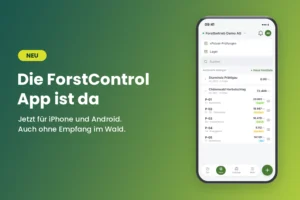
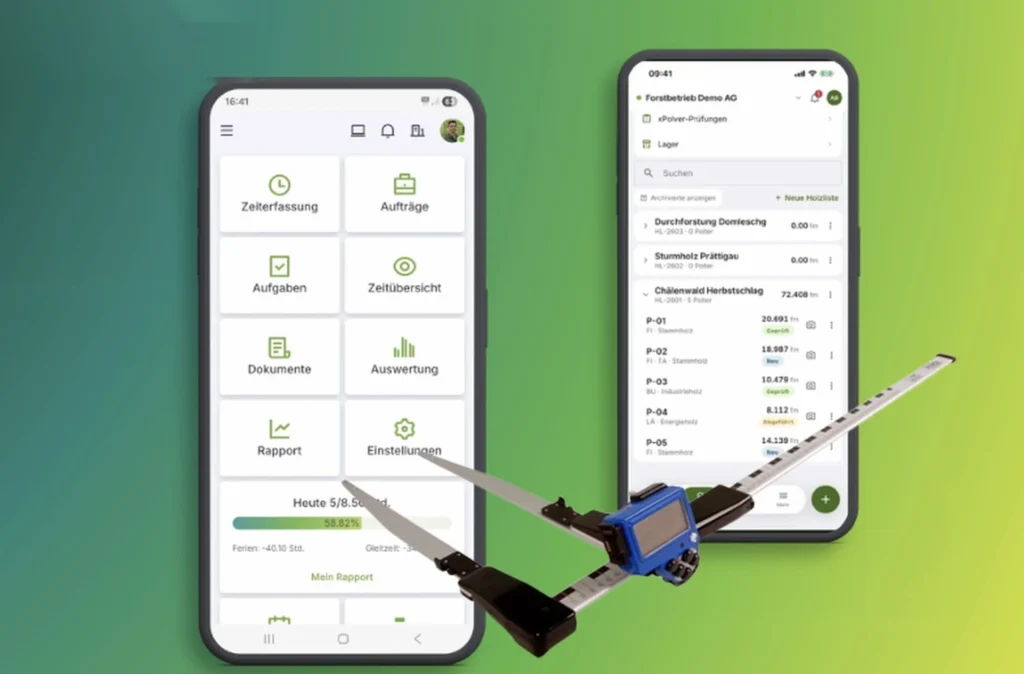
With the Timber management extension, you record standing and felled timber, bill single logs, piles and products directly and analyse by tree species, buyer and season. You connect the Haglöf MDII+ digital calliper via Bluetooth (iOS and Android), and data from the Haglöf DPII+ can be imported. The app also works offline on Samsung and Apple devices and is continuously being developed. With PolterMap you see all piles on the map, book timber in and out, assign hauliers and buyers and keep a history including photos.
Timber management: CHF 576 per year, PolterMap: CHF 138 per year (each excl. VAT).
Frequently asked questions
What is the difference between a stere and a solid cubic metre?
A solid cubic metre is pure wood mass without gaps. A stere is a stacked measure for piled wood including gaps. For firewood logs, the Swiss wood energy statistics use 1 m³ = 1.4 steres. There is no flat-rate factor for roundwood piles: what counts is what you agree with the buyer.
Which rules apply to roundwood measurement in Switzerland?
The Swiss trade customs for raw timber («Schweizer Handelsgebräuche für Rohholz»), 2021 edition, govern assortments, how billable volumes are determined and commercial definitions. They are available from Lignum.
How accurate is photo-based log pile measurement?
It depends on pile quality, how the camera is held and lighting. A field test by FVA Baden-Württemberg (2016) found a deviation of less than ±5 % for 72 % of lots for the stacked volume of industrial wood, and considerably larger deviations for the volume of fixed lengths. For the sale, what counts is the measuring method stated in the contract.
Can I connect a digital calliper to my smartphone?
That depends on the device and the app. ForstControl supports the Haglöf MDII+ via Bluetooth on iOS and Android and imports data from the Haglöf DPII+.
How much does a timber recording app cost?
That depends on the solution and licence. At ForstControl, the Timber management extension costs CHF 576 per year and PolterMap CHF 138 per year (each excl. VAT).
This article replaces neither the rulebook nor advice. The trade customs and the agreement with your buyer are what count.
Sources
All accessed on 27.10.2026.
- Lignum, press release «Neufassung der Holzhandelsgebräuche liegt Ende Juni vor» (in German), 17.05.2021 – lignum.ch (PDF)
- Lignum shop, «Schweizer Handelsgebräuche für Rohholz, Ausgabe 2021» (114 pages; also available in French and Italian) – lignum.ch
- Staudenmaier, J., «Update zur Rohholzvermessung», FVA-einblick 3/2018 (Germany), waldwissen.net – waldwissen.net
- Schweiss, U., field test «Holzpolter mit App vermessen», FVA Baden-Württemberg, 18.11.2016 (Germany), waldwissen.net – waldwissen.net
- Swiss Federal Office of Energy SFOE, «Schweizerische Holzenergiestatistik, Erhebungsjahr 2021» (Swiss wood energy statistics, report August 2022), table I.3 – holzenergie.ch (PDF)
- ForstControl, Timber recording – forstcontrol.com/en/holzerfassung
- ForstControl, Log pile management – forstcontrol.com/en/polterverwaltung
- ForstControl, Prices – forstcontrol.com/preise